
The DFW apartment application process: documents, timeline, and approval odds
By Sofia Kowalski · Updated 2026-07-10

The application process is where a lot of apartment searches stall out, usually because renters find out about a document or income requirement after they’ve already fallen for a unit. Knowing what’s coming ahead of time makes the process faster and lowers the odds of a surprise denial.
What you’ll typically need
- Government-issued ID for every adult who will be on the lease.
- Proof of income, usually recent pay stubs, an offer letter, or two to three months of bank statements if you’re self-employed.
- Social Security number for each applicant, used for the credit and background check.
- Rental history or landlord references, especially if you’re new to the area or have a limited local credit history.
- Application fee, which is usually non-refundable and covers the cost of the screening.
Gathering these before you tour, rather than after you’ve picked a favorite unit, can shave days off the process.
The typical timeline
| Step | What happens | Typical timing |
|---|---|---|
| Submit application | Documents and fee submitted | Same day as your decision to apply |
| Credit and background check | Screening company processes your file | Usually 1 to 2 business days |
| Income verification | Property confirms income meets their threshold | Often same day as the check |
| Decision | Approved, denied, or conditional (with a co-signer or higher deposit) | 1 to 3 business days typically |
| Lease signing | Paperwork and move-in date confirmed | Can happen same day as approval |
The income requirement most renters miss
Most DFW communities set a minimum household income requirement, commonly around 2.5 to 3 times the monthly rent, as part of their approval criteria. This is separate from your own personal budgeting rule of thumb. Even if you feel confident you can afford a unit, the property will check your income against its own threshold, and falling short can mean an automatic denial or a request for a guarantor. Checking this math before you apply for a specific unit saves a wasted application fee.
If your income comes from multiple sources, self-employment, or a recent job change, gather documentation for all of it ahead of time. Screening systems are generally built around a straightforward pay stub, and anything outside that pattern tends to slow down verification unless you’ve already got the paperwork organized to explain it.
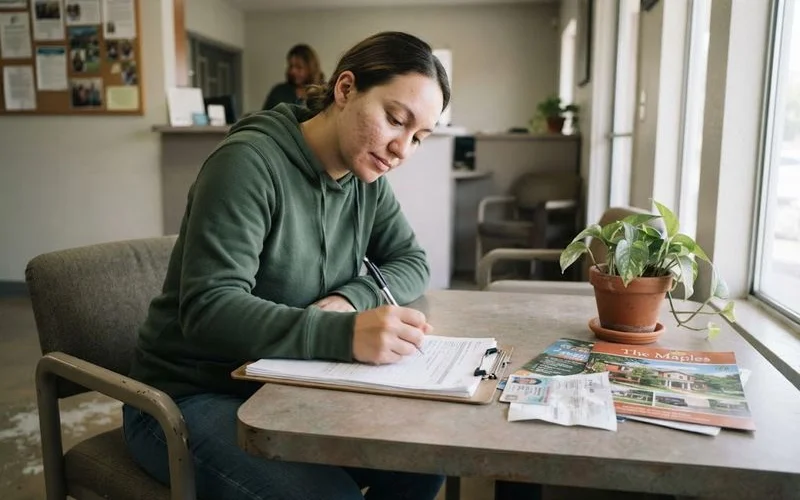
If your income or credit doesn’t clear the bar
Many properties offer alternatives rather than an outright denial: a co-signer or guarantor who meets the income requirement on your behalf, a larger security deposit to offset credit concerns, or, in some cases, proof of savings equivalent to several months of rent. Ask directly what options exist before assuming a denial is final.
A guarantor typically needs to meet a higher income threshold than a standard applicant, often several times the monthly rent on their own, since they’re effectively backing the full lease. If you’re asking a family member or friend to serve in that role, make sure they understand the financial commitment before you list them on the application.
Getting through it smoothly
Apply to more than one property if your situation is borderline, since standards vary between communities even within the same category. Have your documents ready before you tour, not after. And if you are denied, ask for the specific reason. It’s often something you can address, whether that’s a documentation gap, a credit issue, or an income shortfall that a guarantor can solve.
One more thing worth planning around: application fees add up if you’re applying to several properties at once, and they’re generally non-refundable regardless of the outcome. Narrowing your list to two or three realistic options, rather than applying broadly and hoping, tends to save both money and time.
For more on how we factor application experience and resident feedback into our rankings, see our scoring methodology, or return to the directory home page to keep comparing communities.
Questions people ask
- What documents do I need to apply for an apartment in DFW?
- Typically a government-issued ID, proof of income such as recent pay stubs or an offer letter, and your Social Security number for a credit and background check. Some properties also ask for landlord references or bank statements.
- How long does apartment approval usually take?
- Many properties return a decision within a day or two once your application and documents are complete, though it can take longer if income or background checks require manual review.
- What income do I need to qualify?
- Many DFW communities set a minimum around 2.5 to 3 times the monthly rent in gross income. If you don't meet that threshold alone, a guarantor or co-signer can sometimes bridge the gap.
- What if I get denied?
- Ask the property for the specific reason, since it's often fixable, such as insufficient income documentation or a credit issue that a larger deposit or guarantor can offset. Federal fair housing rules mean the reason should relate to your application, not a protected characteristic.